
Insights
Aesthetics vs. Longevity: The Fitness Trap
Aesthetics vs. Longevity: The Fitness Trap
Looking fit and being fit for life are not always the same thing. Discover why a complete fitness baseline goes beyond appearance, and what your body’s performance can reveal.
Looking fit and being fit for life are not always the same thing. Discover why a complete fitness baseline goes beyond appearance, and what your body’s performance can reveal.
There is nothing wrong with wanting to look good.
Building muscle, changing your body composition and feeling more confident can all be positive reasons to train. The problem begins when appearance becomes the only way you measure whether your fitness is working.
A defined physique can show dedication. It cannot tell you everything about your heart, lungs, endurance, grip, balance or control.
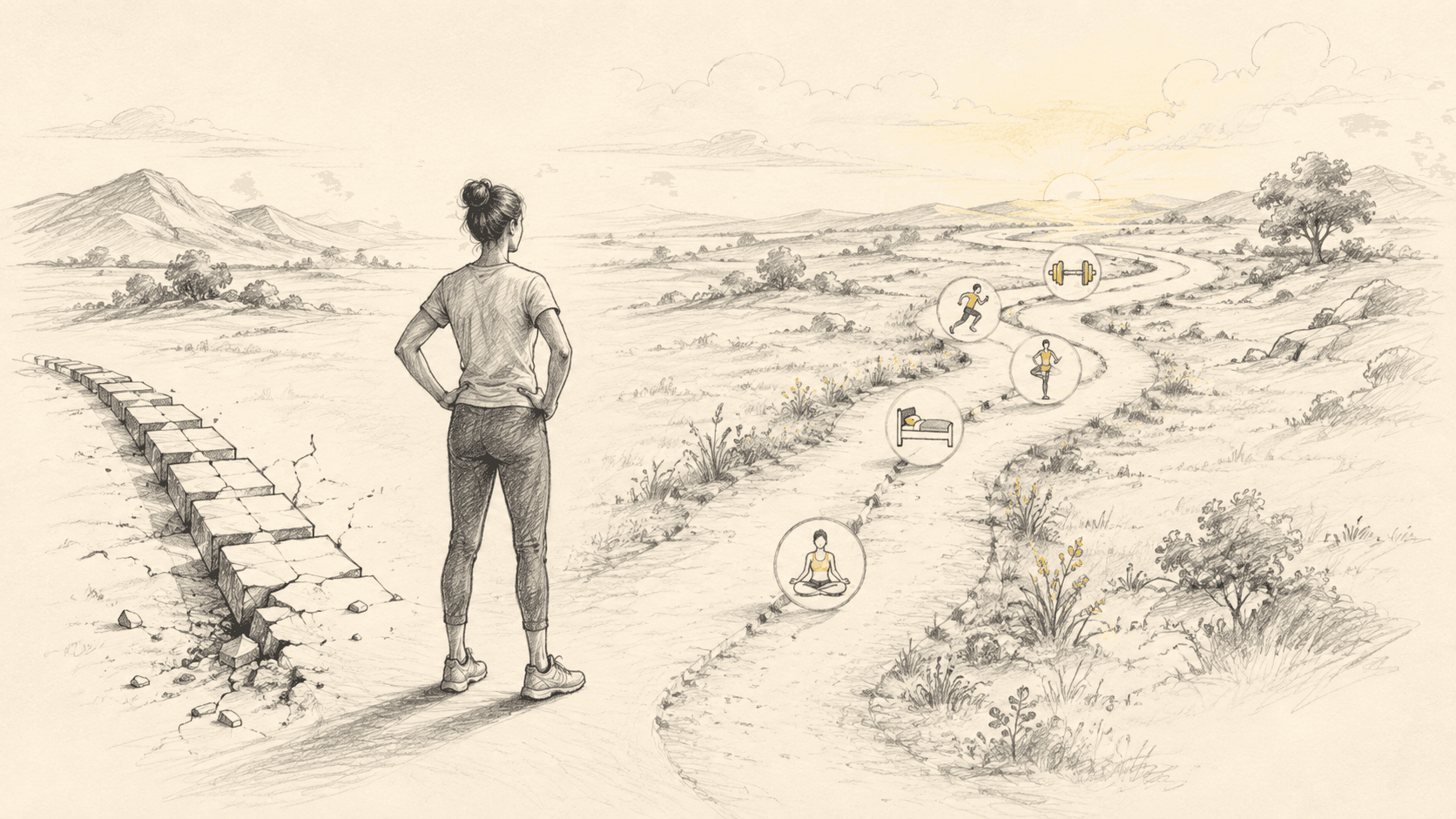
That is the fitness trap: training only for what can be seen while ignoring what needs to perform.
Quick answer: is looking fit the same as being fit?
No. Appearance may reflect certain elements of fitness, but it does not provide a complete picture of how your body performs.
Someone can look athletic while having limited cardiovascular endurance, poor balance or gaps in functional strength. Equally, someone who does not match the traditional image of a “fit” person may demonstrate excellent stamina, strength and control.
Longevity fitness asks a different question: not just how do you look today, but what can your body do, and how well can it keep doing it?
Why aesthetics became the default measure of fitness
Aesthetic progress is visible.
You can see changes in a photograph, notice how clothes fit or follow a number on the scales. That makes appearance an easy source of motivation and an easy story to share.
Performance is often quieter.
You may not immediately see that your aerobic capacity has improved, that you can recover more efficiently or that your grip and lower-body endurance are stronger. These changes usually need to be tested.
That is why people can spend years training consistently without knowing where their biggest physical strengths and weaknesses actually are.
Most people train hard. Very few know what their body genuinely needs.
The problem is not aesthetics
Aesthetics and longevity are not enemies.
You do not have to choose between looking good and building a body that performs well. Resistance training, aerobic exercise, movement and sensible nutrition can support both goals.
The trap is assuming that achieving an aesthetic goal means every important area of fitness is already covered.
It might not be.
A mirror can show shape and definition. It cannot measure your ability to sustain effort, maintain control under fatigue, carry load or recover between challenges.
What does longevity fitness actually mean?
Longevity fitness is about developing the physical qualities that help you remain capable across the different stages of life.
It considers more than one lift, one run time or one photograph. It looks at how different systems work together, including:
Cardiovascular endurance
Muscular strength
Grip and carrying capacity
Lower-body endurance
Balance and coordination
Movement control
Recovery under effort
This does not mean training must become clinical or overly complicated. It means taking a broader view of what “fit” should mean.
Appearance is an outcome. Capacity is an ability.
Aesthetic goals usually focus on an outcome:
Losing body fat
Building visible muscle
Reaching a target weight
Changing a specific part of the body
Longevity goals focus on abilities:
Can you sustain physical effort?
Can you produce and control force?
Can you carry, hold and move weight?
Can you maintain balance when tired?
Can you recover and repeat the effort?
Are you improving in the areas that matter most?
Both types of goal can exist together. The difference is that abilities must be demonstrated rather than assumed.
Cardiovascular fitness cannot be judged by appearance
Cardiorespiratory fitness describes how effectively the heart, lungs and circulatory system support the body during sustained activity.
A 2025 systematic review found that cardiorespiratory fitness provided important information about cardiovascular and all-cause mortality risk across different body-mass-index categories. This does not make body composition irrelevant, but it reinforces that performance measures can reveal information appearance alone cannot.
You cannot reliably estimate that capacity by looking at someone.
You have to test it.
Strength is bigger than visible muscle
Visible muscle and usable strength can overlap, but they are not identical.
Real-world strength includes the ability to:
Hold your own bodyweight
Maintain tension
Carry an awkward load
Produce force repeatedly
Stay stable while moving
Keep control as fatigue builds
Grip strength is one useful example. Research has found associations between lower grip strength and poorer long-term outcomes, which is why it is often treated as a useful marker of broader muscular function. It is not a diagnosis or a prediction of an individual lifespan, but it can contribute to a wider picture of physical capability.
Balance and control deserve attention too
Balance is easy to overlook when training is centred on appearance.
Yet the ability to stabilise the body, coordinate movement and respond to changes in position becomes increasingly relevant as we age. World Health Organization guidance recommends that older adults include activity emphasising balance, coordination and muscle strengthening as part of a varied routine.
Balance is not only something to think about later in life. It is a quality worth developing before it becomes a limitation.
How Vitro moves the focus from appearance to performance
The Vitro Vitality Games is a 10-station fitness assessment built to create a clearer picture of how your body performs.
Rather than relying on one result, the format examines different aspects of your heart, lungs, strength and control.
Your results contribute to your Vitality Score: one combined score that helps turn separate physical tests into a clearer baseline.
10 stations. 1 score. A clear baseline.
The aim is not to decide whether you look fit. It is to show where your current capabilities are strong, where there may be room to improve and where your training could become more purposeful.
Your score is a training roadmap, not a judgement
One of the biggest problems with appearance-led fitness is that progress can become emotional.
A photograph you dislike can make months of training feel pointless. A number on the scales can affect how you judge an otherwise productive week.
Performance data offers a different perspective.
A score gives you something practical to work from. It helps you replace vague questions such as “Am I fit enough?” with more useful ones:
Which area is currently strongest?
Where am I losing performance?
Is my endurance keeping pace with my strength?
Am I improving the qualities I usually avoid?
What should I focus on during my next training phase?
There is no failing. There is only finding out where you are.
What a complete fitness baseline can reveal
Imagine two people who appear equally athletic.
One may perform strongly during shorter strength efforts but struggle when activity has to be sustained. The other may have good endurance but find grip, balance or force control more challenging.
Neither result makes one person “fit” and the other “unfit”. It shows that fitness is multidimensional.
That is the value of a broader assessment. It exposes the gaps a mirror cannot show.
Five questions to audit your current training
Before changing your programme, ask yourself:
1. Am I training my heart and lungs?
UK guidance recommends that adults work towards at least 150 minutes of moderate-intensity activity or 75 minutes of vigorous-intensity activity each week.
The exact approach should suit your current ability and health, but some form of sustained aerobic work deserves a place alongside resistance training.
2. Am I building strength beyond one movement?
A strong programme should not depend entirely on one favourite lift or machine.
Consider how your training develops your legs, hips, back, abdomen, chest, shoulders, arms and grip. NHS guidance recommends muscle-strengthening activity involving the major muscle groups on at least two days each week.
3. Do I practise balance and control?
Include movements that require stability, coordination and deliberate control rather than always relying on fixed machines or supported positions.
4. Can I maintain performance under fatigue?
Being able to complete one strong repetition is useful. Being able to maintain technique and control as an effort continues tells you something different.
5. Do I have a measurable baseline?
Without a baseline, it is easy to confuse effort with progress.
You might be working hard without addressing the areas that need the most attention. A structured assessment gives your training a clearer starting point.
Train for both not one or the other
You can still train for muscle. You can still work towards fat loss. You can still care about how you look.
The better approach is to include performance alongside appearance.
Build the physique you want, but also build the engine, strength, balance and control you want to carry into the future.
That is training for life.
Frequently asked questions
Is aesthetic training bad for longevity?
No. Training to build muscle or improve body composition can sit comfortably alongside longevity-focused fitness.
Problems arise when appearance is treated as the only measure of progress and other qualities, such as aerobic fitness, strength, balance and control, are ignored.
Can someone look fit but have poor cardiovascular fitness?
Yes. Physical appearance does not directly measure how effectively someone can sustain aerobic effort.
Cardiovascular capacity needs to be assessed through appropriate activity or testing rather than estimated from body shape.
Does having visible muscle mean you are functionally strong?
Not necessarily.
Muscle size may contribute to strength, but functional performance also depends on factors such as movement skill, grip, stability, coordination and the ability to maintain force under fatigue.
What is a longevity fitness assessment?
A longevity fitness assessment looks at several physical qualities that contribute to long-term capability rather than relying on one exercise or appearance-based measurement.
At Vitro, participants complete 10 stations designed to assess different elements of heart, lung, strength and control performance.
Do I need to be fit before taking part in Vitro?
No. Vitro is designed to give you a starting point.
Every station has a minimum scoring threshold when attempted. The goal is not to arrive with a perfect score. It is to understand where you are now so you can train with greater direction.
People who have not exercised for some time, or who have a health condition or concern, should seek appropriate medical advice before beginning a new or demanding exercise programme. The NHS also recommends making sure activity and intensity are appropriate for your current fitness.
Find out what your body can do
Stop using appearance as your only fitness score.
Ready to find your baseline? View the next VITRO Vitality Games event.
Published by VITRO Vitality Games. Educational fitness information only — not medical advice, diagnosis or treatment. If you have a health condition or concern, seek advice from a qualified healthcare professional.
Latest Blogs


Insights
Aesthetics vs. Longevity: The Fitness Trap
Aesthetics vs. Longevity: The Fitness Trap
Looking fit and being fit for life are not always the same thing. Discover why a complete fitness baseline goes beyond appearance, and what your body’s performance can reveal.
Looking fit and being fit for life are not always the same thing. Discover why a complete fitness baseline goes beyond appearance, and what your body’s performance can reveal.
There is nothing wrong with wanting to look good.
Building muscle, changing your body composition and feeling more confident can all be positive reasons to train. The problem begins when appearance becomes the only way you measure whether your fitness is working.
A defined physique can show dedication. It cannot tell you everything about your heart, lungs, endurance, grip, balance or control.
That is the fitness trap: training only for what can be seen while ignoring what needs to perform.
Quick answer: is looking fit the same as being fit?
No. Appearance may reflect certain elements of fitness, but it does not provide a complete picture of how your body performs.
Someone can look athletic while having limited cardiovascular endurance, poor balance or gaps in functional strength. Equally, someone who does not match the traditional image of a “fit” person may demonstrate excellent stamina, strength and control.
Longevity fitness asks a different question: not just how do you look today, but what can your body do, and how well can it keep doing it?
Why aesthetics became the default measure of fitness
Aesthetic progress is visible.
You can see changes in a photograph, notice how clothes fit or follow a number on the scales. That makes appearance an easy source of motivation and an easy story to share.
Performance is often quieter.
You may not immediately see that your aerobic capacity has improved, that you can recover more efficiently or that your grip and lower-body endurance are stronger. These changes usually need to be tested.
That is why people can spend years training consistently without knowing where their biggest physical strengths and weaknesses actually are.
Most people train hard. Very few know what their body genuinely needs.
The problem is not aesthetics
Aesthetics and longevity are not enemies.
You do not have to choose between looking good and building a body that performs well. Resistance training, aerobic exercise, movement and sensible nutrition can support both goals.
The trap is assuming that achieving an aesthetic goal means every important area of fitness is already covered.
It might not be.
A mirror can show shape and definition. It cannot measure your ability to sustain effort, maintain control under fatigue, carry load or recover between challenges.
What does longevity fitness actually mean?
Longevity fitness is about developing the physical qualities that help you remain capable across the different stages of life.
It considers more than one lift, one run time or one photograph. It looks at how different systems work together, including:
Cardiovascular endurance
Muscular strength
Grip and carrying capacity
Lower-body endurance
Balance and coordination
Movement control
Recovery under effort
This does not mean training must become clinical or overly complicated. It means taking a broader view of what “fit” should mean.
Appearance is an outcome. Capacity is an ability.
Aesthetic goals usually focus on an outcome:
Losing body fat
Building visible muscle
Reaching a target weight
Changing a specific part of the body
Longevity goals focus on abilities:
Can you sustain physical effort?
Can you produce and control force?
Can you carry, hold and move weight?
Can you maintain balance when tired?
Can you recover and repeat the effort?
Are you improving in the areas that matter most?
Both types of goal can exist together. The difference is that abilities must be demonstrated rather than assumed.
Cardiovascular fitness cannot be judged by appearance
Cardiorespiratory fitness describes how effectively the heart, lungs and circulatory system support the body during sustained activity.
A 2025 systematic review found that cardiorespiratory fitness provided important information about cardiovascular and all-cause mortality risk across different body-mass-index categories. This does not make body composition irrelevant, but it reinforces that performance measures can reveal information appearance alone cannot.
You cannot reliably estimate that capacity by looking at someone.
You have to test it.
Strength is bigger than visible muscle
Visible muscle and usable strength can overlap, but they are not identical.
Real-world strength includes the ability to:
Hold your own bodyweight
Maintain tension
Carry an awkward load
Produce force repeatedly
Stay stable while moving
Keep control as fatigue builds
Grip strength is one useful example. Research has found associations between lower grip strength and poorer long-term outcomes, which is why it is often treated as a useful marker of broader muscular function. It is not a diagnosis or a prediction of an individual lifespan, but it can contribute to a wider picture of physical capability.
Balance and control deserve attention too
Balance is easy to overlook when training is centred on appearance.
Yet the ability to stabilise the body, coordinate movement and respond to changes in position becomes increasingly relevant as we age. World Health Organization guidance recommends that older adults include activity emphasising balance, coordination and muscle strengthening as part of a varied routine.
Balance is not only something to think about later in life. It is a quality worth developing before it becomes a limitation.
How Vitro moves the focus from appearance to performance
The Vitro Vitality Games is a 10-station fitness assessment built to create a clearer picture of how your body performs.
Rather than relying on one result, the format examines different aspects of your heart, lungs, strength and control.
Your results contribute to your Vitality Score: one combined score that helps turn separate physical tests into a clearer baseline.
10 stations. 1 score. A clear baseline.
The aim is not to decide whether you look fit. It is to show where your current capabilities are strong, where there may be room to improve and where your training could become more purposeful.
Your score is a training roadmap, not a judgement
One of the biggest problems with appearance-led fitness is that progress can become emotional.
A photograph you dislike can make months of training feel pointless. A number on the scales can affect how you judge an otherwise productive week.
Performance data offers a different perspective.
A score gives you something practical to work from. It helps you replace vague questions such as “Am I fit enough?” with more useful ones:
Which area is currently strongest?
Where am I losing performance?
Is my endurance keeping pace with my strength?
Am I improving the qualities I usually avoid?
What should I focus on during my next training phase?
There is no failing. There is only finding out where you are.
What a complete fitness baseline can reveal
Imagine two people who appear equally athletic.
One may perform strongly during shorter strength efforts but struggle when activity has to be sustained. The other may have good endurance but find grip, balance or force control more challenging.
Neither result makes one person “fit” and the other “unfit”. It shows that fitness is multidimensional.
That is the value of a broader assessment. It exposes the gaps a mirror cannot show.
Five questions to audit your current training
Before changing your programme, ask yourself:
1. Am I training my heart and lungs?
UK guidance recommends that adults work towards at least 150 minutes of moderate-intensity activity or 75 minutes of vigorous-intensity activity each week.
The exact approach should suit your current ability and health, but some form of sustained aerobic work deserves a place alongside resistance training.
2. Am I building strength beyond one movement?
A strong programme should not depend entirely on one favourite lift or machine.
Consider how your training develops your legs, hips, back, abdomen, chest, shoulders, arms and grip. NHS guidance recommends muscle-strengthening activity involving the major muscle groups on at least two days each week.
3. Do I practise balance and control?
Include movements that require stability, coordination and deliberate control rather than always relying on fixed machines or supported positions.
4. Can I maintain performance under fatigue?
Being able to complete one strong repetition is useful. Being able to maintain technique and control as an effort continues tells you something different.
5. Do I have a measurable baseline?
Without a baseline, it is easy to confuse effort with progress.
You might be working hard without addressing the areas that need the most attention. A structured assessment gives your training a clearer starting point.
Train for both not one or the other
You can still train for muscle. You can still work towards fat loss. You can still care about how you look.
The better approach is to include performance alongside appearance.
Build the physique you want, but also build the engine, strength, balance and control you want to carry into the future.
That is training for life.
Frequently asked questions
Is aesthetic training bad for longevity?
No. Training to build muscle or improve body composition can sit comfortably alongside longevity-focused fitness.
Problems arise when appearance is treated as the only measure of progress and other qualities, such as aerobic fitness, strength, balance and control, are ignored.
Can someone look fit but have poor cardiovascular fitness?
Yes. Physical appearance does not directly measure how effectively someone can sustain aerobic effort.
Cardiovascular capacity needs to be assessed through appropriate activity or testing rather than estimated from body shape.
Does having visible muscle mean you are functionally strong?
Not necessarily.
Muscle size may contribute to strength, but functional performance also depends on factors such as movement skill, grip, stability, coordination and the ability to maintain force under fatigue.
What is a longevity fitness assessment?
A longevity fitness assessment looks at several physical qualities that contribute to long-term capability rather than relying on one exercise or appearance-based measurement.
At Vitro, participants complete 10 stations designed to assess different elements of heart, lung, strength and control performance.
Do I need to be fit before taking part in Vitro?
No. Vitro is designed to give you a starting point.
Every station has a minimum scoring threshold when attempted. The goal is not to arrive with a perfect score. It is to understand where you are now so you can train with greater direction.
People who have not exercised for some time, or who have a health condition or concern, should seek appropriate medical advice before beginning a new or demanding exercise programme. The NHS also recommends making sure activity and intensity are appropriate for your current fitness.
Find out what your body can do
Stop using appearance as your only fitness score.
Ready to find your baseline? View the next VITRO Vitality Games event.
Published by VITRO Vitality Games. Educational fitness information only — not medical advice, diagnosis or treatment. If you have a health condition or concern, seek advice from a qualified healthcare professional.
Latest Blogs
Insights
Aesthetics vs. Longevity: The Fitness Trap
Aesthetics vs. Longevity: The Fitness Trap
Looking fit and being fit for life are not always the same thing. Discover why a complete fitness baseline goes beyond appearance, and what your body’s performance can reveal.
Looking fit and being fit for life are not always the same thing. Discover why a complete fitness baseline goes beyond appearance, and what your body’s performance can reveal.
There is nothing wrong with wanting to look good.
Building muscle, changing your body composition and feeling more confident can all be positive reasons to train. The problem begins when appearance becomes the only way you measure whether your fitness is working.
A defined physique can show dedication. It cannot tell you everything about your heart, lungs, endurance, grip, balance or control.
That is the fitness trap: training only for what can be seen while ignoring what needs to perform.
Quick answer: is looking fit the same as being fit?
No. Appearance may reflect certain elements of fitness, but it does not provide a complete picture of how your body performs.
Someone can look athletic while having limited cardiovascular endurance, poor balance or gaps in functional strength. Equally, someone who does not match the traditional image of a “fit” person may demonstrate excellent stamina, strength and control.
Longevity fitness asks a different question: not just how do you look today, but what can your body do, and how well can it keep doing it?
Why aesthetics became the default measure of fitness
Aesthetic progress is visible.
You can see changes in a photograph, notice how clothes fit or follow a number on the scales. That makes appearance an easy source of motivation and an easy story to share.
Performance is often quieter.
You may not immediately see that your aerobic capacity has improved, that you can recover more efficiently or that your grip and lower-body endurance are stronger. These changes usually need to be tested.
That is why people can spend years training consistently without knowing where their biggest physical strengths and weaknesses actually are.
Most people train hard. Very few know what their body genuinely needs.
The problem is not aesthetics
Aesthetics and longevity are not enemies.
You do not have to choose between looking good and building a body that performs well. Resistance training, aerobic exercise, movement and sensible nutrition can support both goals.
The trap is assuming that achieving an aesthetic goal means every important area of fitness is already covered.
It might not be.
A mirror can show shape and definition. It cannot measure your ability to sustain effort, maintain control under fatigue, carry load or recover between challenges.
What does longevity fitness actually mean?
Longevity fitness is about developing the physical qualities that help you remain capable across the different stages of life.
It considers more than one lift, one run time or one photograph. It looks at how different systems work together, including:
Cardiovascular endurance
Muscular strength
Grip and carrying capacity
Lower-body endurance
Balance and coordination
Movement control
Recovery under effort
This does not mean training must become clinical or overly complicated. It means taking a broader view of what “fit” should mean.
Appearance is an outcome. Capacity is an ability.
Aesthetic goals usually focus on an outcome:
Losing body fat
Building visible muscle
Reaching a target weight
Changing a specific part of the body
Longevity goals focus on abilities:
Can you sustain physical effort?
Can you produce and control force?
Can you carry, hold and move weight?
Can you maintain balance when tired?
Can you recover and repeat the effort?
Are you improving in the areas that matter most?
Both types of goal can exist together. The difference is that abilities must be demonstrated rather than assumed.
Cardiovascular fitness cannot be judged by appearance
Cardiorespiratory fitness describes how effectively the heart, lungs and circulatory system support the body during sustained activity.
A 2025 systematic review found that cardiorespiratory fitness provided important information about cardiovascular and all-cause mortality risk across different body-mass-index categories. This does not make body composition irrelevant, but it reinforces that performance measures can reveal information appearance alone cannot.
You cannot reliably estimate that capacity by looking at someone.
You have to test it.
Strength is bigger than visible muscle
Visible muscle and usable strength can overlap, but they are not identical.
Real-world strength includes the ability to:
Hold your own bodyweight
Maintain tension
Carry an awkward load
Produce force repeatedly
Stay stable while moving
Keep control as fatigue builds
Grip strength is one useful example. Research has found associations between lower grip strength and poorer long-term outcomes, which is why it is often treated as a useful marker of broader muscular function. It is not a diagnosis or a prediction of an individual lifespan, but it can contribute to a wider picture of physical capability.
Balance and control deserve attention too
Balance is easy to overlook when training is centred on appearance.
Yet the ability to stabilise the body, coordinate movement and respond to changes in position becomes increasingly relevant as we age. World Health Organization guidance recommends that older adults include activity emphasising balance, coordination and muscle strengthening as part of a varied routine.
Balance is not only something to think about later in life. It is a quality worth developing before it becomes a limitation.
How Vitro moves the focus from appearance to performance
The Vitro Vitality Games is a 10-station fitness assessment built to create a clearer picture of how your body performs.
Rather than relying on one result, the format examines different aspects of your heart, lungs, strength and control.
Your results contribute to your Vitality Score: one combined score that helps turn separate physical tests into a clearer baseline.
10 stations. 1 score. A clear baseline.
The aim is not to decide whether you look fit. It is to show where your current capabilities are strong, where there may be room to improve and where your training could become more purposeful.
Your score is a training roadmap, not a judgement
One of the biggest problems with appearance-led fitness is that progress can become emotional.
A photograph you dislike can make months of training feel pointless. A number on the scales can affect how you judge an otherwise productive week.
Performance data offers a different perspective.
A score gives you something practical to work from. It helps you replace vague questions such as “Am I fit enough?” with more useful ones:
Which area is currently strongest?
Where am I losing performance?
Is my endurance keeping pace with my strength?
Am I improving the qualities I usually avoid?
What should I focus on during my next training phase?
There is no failing. There is only finding out where you are.
What a complete fitness baseline can reveal
Imagine two people who appear equally athletic.
One may perform strongly during shorter strength efforts but struggle when activity has to be sustained. The other may have good endurance but find grip, balance or force control more challenging.
Neither result makes one person “fit” and the other “unfit”. It shows that fitness is multidimensional.
That is the value of a broader assessment. It exposes the gaps a mirror cannot show.
Five questions to audit your current training
Before changing your programme, ask yourself:
1. Am I training my heart and lungs?
UK guidance recommends that adults work towards at least 150 minutes of moderate-intensity activity or 75 minutes of vigorous-intensity activity each week.
The exact approach should suit your current ability and health, but some form of sustained aerobic work deserves a place alongside resistance training.
2. Am I building strength beyond one movement?
A strong programme should not depend entirely on one favourite lift or machine.
Consider how your training develops your legs, hips, back, abdomen, chest, shoulders, arms and grip. NHS guidance recommends muscle-strengthening activity involving the major muscle groups on at least two days each week.
3. Do I practise balance and control?
Include movements that require stability, coordination and deliberate control rather than always relying on fixed machines or supported positions.
4. Can I maintain performance under fatigue?
Being able to complete one strong repetition is useful. Being able to maintain technique and control as an effort continues tells you something different.
5. Do I have a measurable baseline?
Without a baseline, it is easy to confuse effort with progress.
You might be working hard without addressing the areas that need the most attention. A structured assessment gives your training a clearer starting point.
Train for both not one or the other
You can still train for muscle. You can still work towards fat loss. You can still care about how you look.
The better approach is to include performance alongside appearance.
Build the physique you want, but also build the engine, strength, balance and control you want to carry into the future.
That is training for life.
Frequently asked questions
Is aesthetic training bad for longevity?
No. Training to build muscle or improve body composition can sit comfortably alongside longevity-focused fitness.
Problems arise when appearance is treated as the only measure of progress and other qualities, such as aerobic fitness, strength, balance and control, are ignored.
Can someone look fit but have poor cardiovascular fitness?
Yes. Physical appearance does not directly measure how effectively someone can sustain aerobic effort.
Cardiovascular capacity needs to be assessed through appropriate activity or testing rather than estimated from body shape.
Does having visible muscle mean you are functionally strong?
Not necessarily.
Muscle size may contribute to strength, but functional performance also depends on factors such as movement skill, grip, stability, coordination and the ability to maintain force under fatigue.
What is a longevity fitness assessment?
A longevity fitness assessment looks at several physical qualities that contribute to long-term capability rather than relying on one exercise or appearance-based measurement.
At Vitro, participants complete 10 stations designed to assess different elements of heart, lung, strength and control performance.
Do I need to be fit before taking part in Vitro?
No. Vitro is designed to give you a starting point.
Every station has a minimum scoring threshold when attempted. The goal is not to arrive with a perfect score. It is to understand where you are now so you can train with greater direction.
People who have not exercised for some time, or who have a health condition or concern, should seek appropriate medical advice before beginning a new or demanding exercise programme. The NHS also recommends making sure activity and intensity are appropriate for your current fitness.
Find out what your body can do
Stop using appearance as your only fitness score.
Ready to find your baseline? View the next VITRO Vitality Games event.
Published by VITRO Vitality Games. Educational fitness information only — not medical advice, diagnosis or treatment. If you have a health condition or concern, seek advice from a qualified healthcare professional.